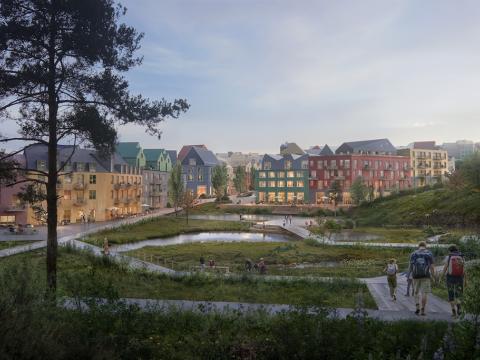
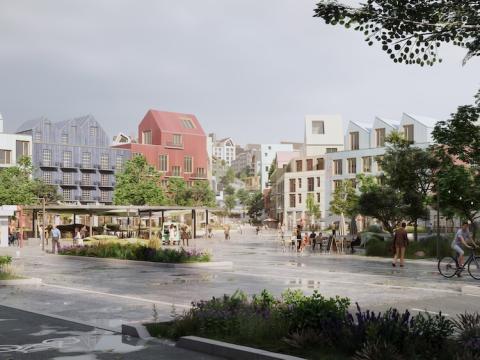
Keldnaland will become a district offering residents and visitors all the benefits of compact, vibrant urban living, according to the winning proposal in an international competition to develop the area, organized by Reykjavík City and Transport for the Capital Area. The awards ceremony took place today at Reykjavík City Hall.
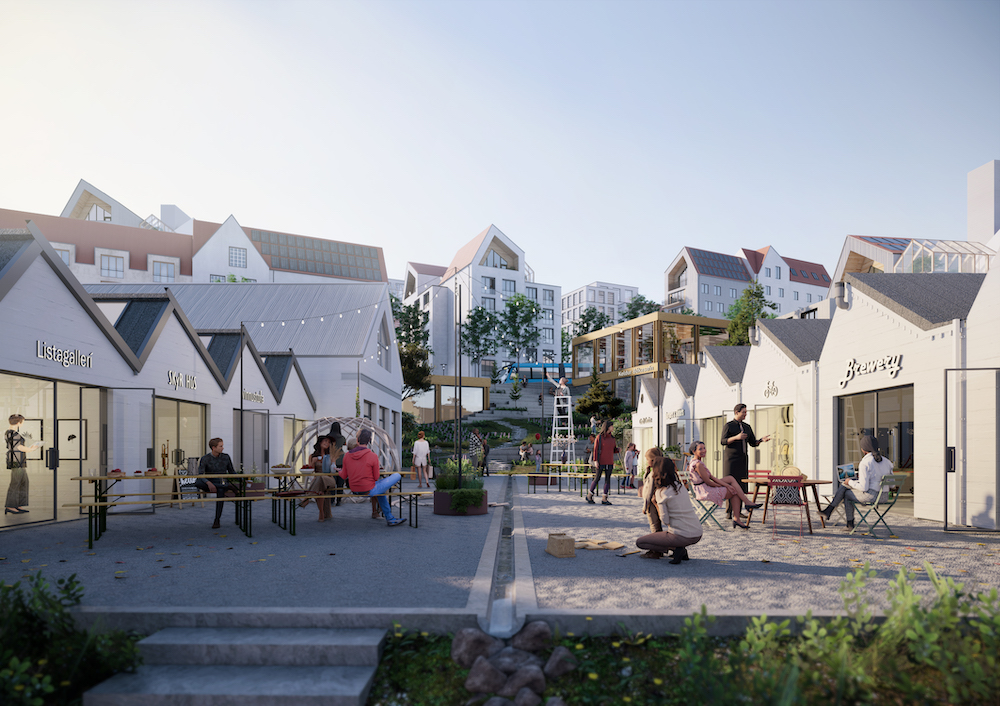
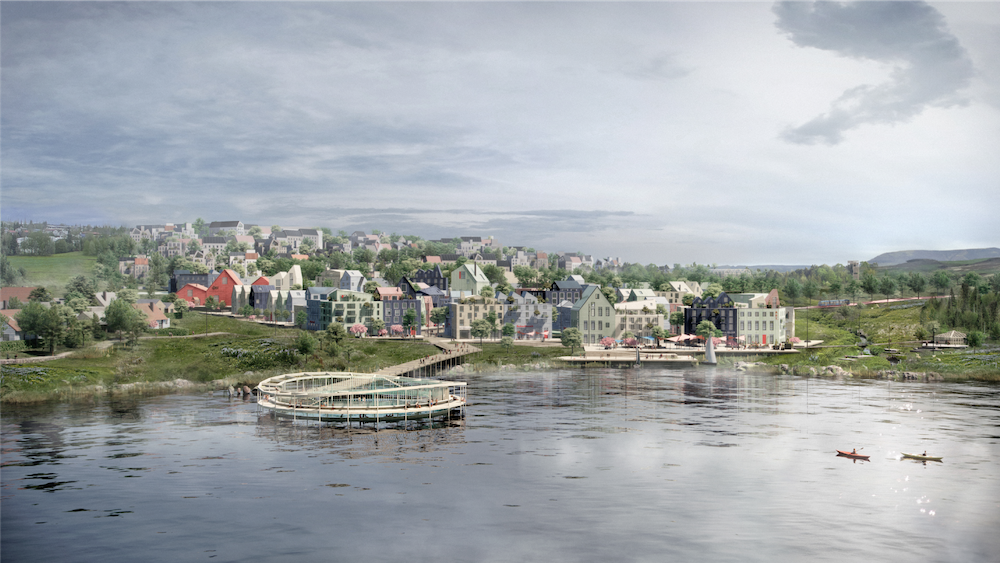
Swedish architecture firm FOJAB developed the winning proposal, with engineering firm Ramboll providing consulting services. The proposal emphasizes making it easy for residents to lead sustainable, healthy everyday lives through access to nature, green spaces, neighborhood parks, and squares.
“Planning a new neighborhood at Keldur marks an exciting milestone in the city’s development,” says Mayor Dagur B. Eggertsson, chair of the selection committee for the development of Keldnaland.
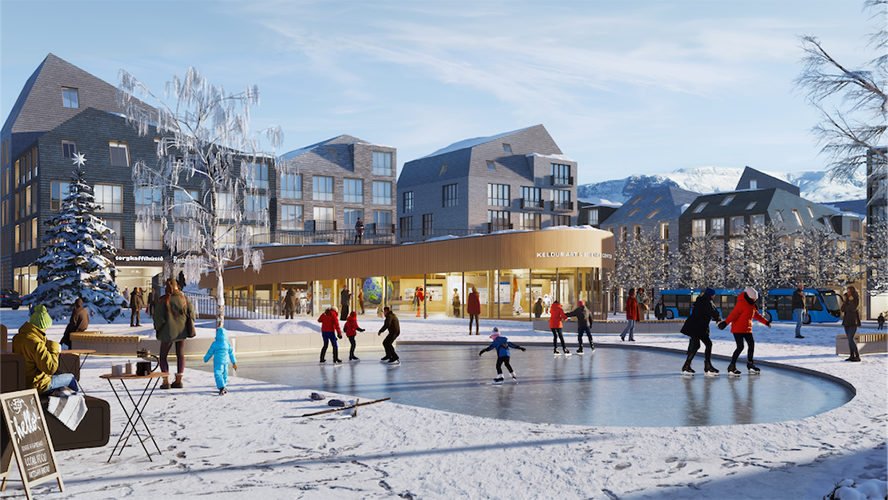
Keldur will be a groundbreaking neighborhood planned around the arrival of CityLine, with strong support for walking, cycling, and other active transportation from day one. The neighborhood will be vibrant, exciting, and welcoming.
“Keldur will be a compact, diverse and green urban neighborhood that benefits from easy access to nature and high-quality public transportation with CityLine. Among the features that will make Keldur a groundbreaking neighborhood are plans built around the arrival of CityLine and strong support for walking, cycling, and other active transportation from day one. The neighborhood will be vibrant, exciting, and welcoming,” he says.
A useful guide for the development work ahead
Two additional proposals received recognition. The winning proposal and the two recognized entries provide a solid foundation for a brief to guide further design and development work. Plans call for at least 10,000 people to live in the area and 5,000 to work there.
The goal is to build an exciting modern neighborhood, Keldnaland, based on eco-friendly transportation and fostering a carbon-neutral urban society. This goal aligns with plans for CityLine to run through the neighborhood, with an emphasis on services and business activity around its stations. The aim is for CityLine service to begin when the first 100 homes are handed over. Estimated travel time to Lækjartorg on CityLine is about 20 minutes.
Ambitious urban development goals
The selection committee’s report states that the challenges set out in the competition brief reflect ambitious urban development goals unprecedented in Iceland. “Some of these goals may be viewed with skepticism, such as those concerning carbon neutrality and a truly diverse range of transportation options in a city where residents depend on private cars and development is relatively spread out for the size of its population. After reviewing the proposals, however, the selection committee considers it even more realistic that the goals will be met and that Keldnaland will set an important precedent for the design of other new neighborhoods,” the report states.
The goal is a vibrant urban environment
The proposal is based on a regular pattern of development blocks along a convincing and realistic route for CityLine, with well-positioned stations and neighborhood centers. This makes efficient use of the land and allows flexibility in how density is distributed while providing easy routes through the neighborhood,” the selection committee’s report says of the winning proposal, also noting that it presents a detailed, carefully considered route network for all modes of transportation that aligns well with the mix of uses and the location of services.
Magdalena Hedman, an architect and the proposal’s project manager at FOJAB, says the focus on carbon neutrality shapes the planning work, as does the fact that this type of urban neighborhood is relatively uncommon in Iceland. “The architecture in our proposal is designed at a human scale—three to five stories—while still being dense and well connected enough to create a vibrant urban environment,” she says.
Total scores determined the outcome
The competition, which began in January this year, took place in two stages. A total of 36 proposals were submitted, with five selected for further development. The competition was anonymous at both stages, and the selection committee did not know which team had prepared each proposal when evaluating and scoring them. The total score, based on an assessment of 14 criteria, determined the outcome. Each team was paid 50,000 euro for its work in the second stage, and the winning proposal will receive an additional 50,000 euro.
The five proposals are the winning entry, Crafting Keldur, which received 536 points; Connect Fast + Live Slow (420 points — honorable mention); Urban Life Meets Keldur Park (396 points — honorable mention); The Green River (314 points); and Keldur - weaving natural and urban fabrics (311 points).
Design and planning work ahead
It is important to remember that development and planning are still at an early stage, even though the competition has ended, and that a solid brief is now in place to guide further work. The approaches and visuals in the proposals need substantial refinement and will change as planning and design continue, before development plans are approved and construction can begin. Planning and development will be divided into smaller phases, and building a neighborhood of this size and population will clearly take time.
Reykjavík City and Transport for the Capital Area are starting the next stage of the area’s development. Work now begins on formal proposals in consultation with stakeholders, residents, and advisors to further develop existing ideas, prepare a framework section of Reykjavík's municipal plan for the area, and draw up a land-use plan for the first phases of development.
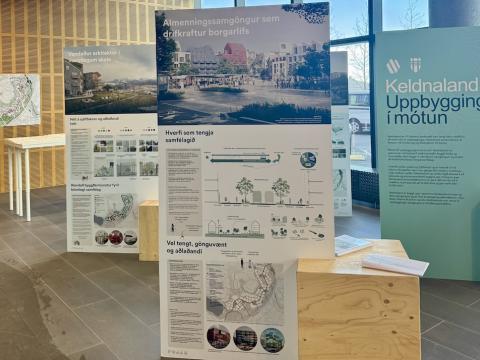
An exhibit of the five proposals is on display in Tjarnarsalur at Reykjavík City Hall through Oct. 2. Everyone is welcome.
Images from the winning proposal