
Reykjavík Family Park and Zoo
Don't fur-get the animals!
More than farm animals
The park is home to far more animals than many people realize.
Alongside familiar farm animals, visitors will find Arctic foxes, reindeer, and seals.
It also features a variety of exotic animals, including reptiles and amphibians.

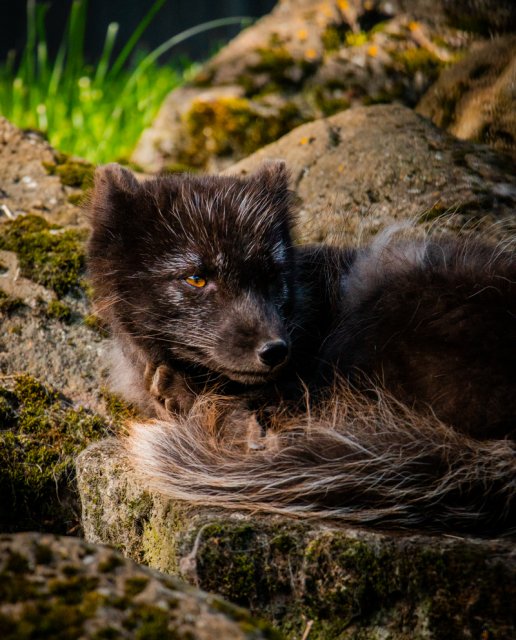
Arctic fox
The Arctic fox is the only mammal that reached Iceland without human assistance. The first Arctic foxes likely crossed over on sea ice at the end of the last ice age, roughly 10,000 years ago. Iceland's Arctic fox population features two main color variants: white and blue, with blue being more common.
Arctic foxes are monogamous, living in pairs and defending a defined home range, known as a territory, against rivals. They forage within this area and mark its boundaries with urine. Both parents work together to raise their cubs. Sometimes, one or more of the pair's year-old daughters also help raise their younger siblings. Arctic foxes can therefore be described as naturally family-oriented.
Family structure
Dog fox, vixen, and cub
Breeding season
Early spring
Number of offspring
Six cubs on average
Arrival in Iceland
Most likely about 10,000 years ago
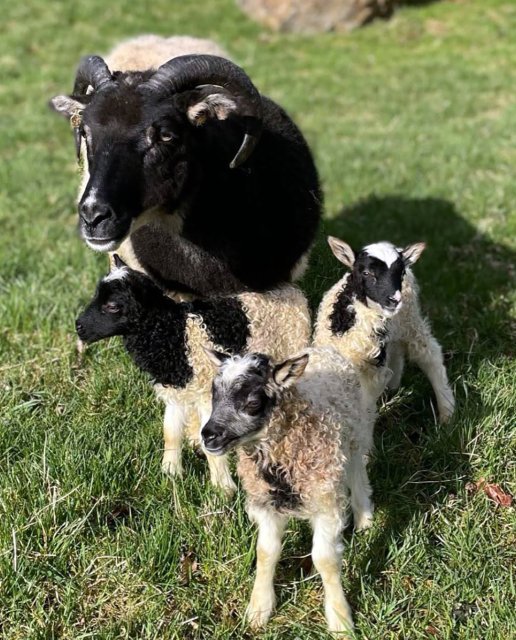
Icelandic sheep
Icelandic sheep have lived in Iceland since the settlement era and most likely descend from the northern European short-tailed breed. Most other European sheep breeds have long tails. Icelandic sheep share many characteristics with the historic Norwegian short-tailed breed.
Both breeds can be gray, badger-faced, mouflon-patterned, black, or brown, and both can have short tails and horns. Sheep are generally social animals, and rams mate with multiple ewes.
Wild sheep typically live in small flocks of fewer than 10, though groups exceeding 100 have been recorded. Flocks are often separated by sex: Ewes and lambs stay together, while rams form their own groups outside the breeding season.
Family structure
Ram, ewe, and lamb
Breeding season
Peaks in December and January
Number of offspring
1–2 lambs (sometimes more)
Arrival in Iceland
During the settlement era
Weight
Rams: 80–100 kg; ewes: 60–70 kg
Gestation period
142–145 days (just under five months)
Uses
Wool, meat, hides, and horns
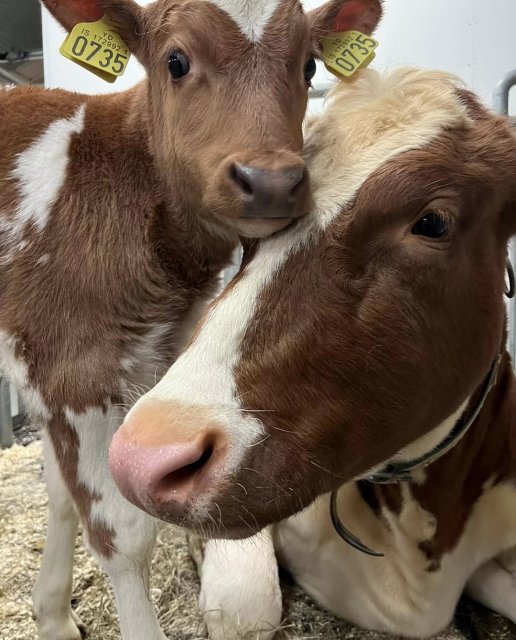
Icelandic cattle
Icelandic cattle are raised primarily for dairy, and all milk production in Iceland relies on this breed. Icelandic cattle come in a wide variety of colors but are relatively small compared to other breeds. The vast majority of Icelandic cattle are polled, meaning they naturally lack horns.
As ruminants, cattle have stomachs with four distinct compartments. They initially swallow grass with little chewing; it then enters the rumen, where it is churned and broken down. The animal then chews its cud, regurgitating the food to chew it a second time. The finely ground food then passes through the remaining three stomach compartments: the reticulum, omasum, and abomasum. There, the food is digested further before moving into the intestines.
Family structure
Bull, cow, and calf
Breeding season
Year-round
Number of offspring
1 calf (rarely 2)
Arrival in Iceland
During the settlement era
Weight
Cows: 450 kg; bulls: 600 kg.
Gestation period
9 months
Uses
Milk, meat, hides, and horns
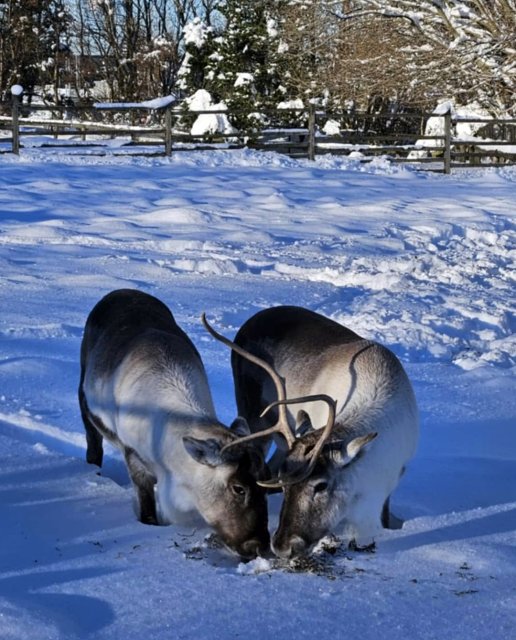
Reindeer
Reindeer in Iceland descend from herds brought from northern Scandinavia in the late 18th century and have lived wild in Iceland ever since. Reindeer have hollow hairs that provide exceptional insulation. For example, they can withstand temperatures as low as minus 40 degrees Celsius without increasing their metabolic rate to minimize heat loss.
They are the only deer species in which both sexes grow antlers. Even so, roughly 4% of the population naturally lacks antlers. Reindeer shed their antlers annually: Males drop theirs after the late-fall breeding season, while females shed theirs when calves are born in the spring. New antlers then grow in their place.
Family structure
Bull, cow, and calf
Breeding season
Begins in late September or early October and lasts three to five weeks
Number of offspring
One calf
Arrival in Iceland
In 1771
Weight
Bulls: 120–200 kg; cows: 80–100 kg.
Gestation period
Just over seven months
Uses
Meat, pelts, and antlers
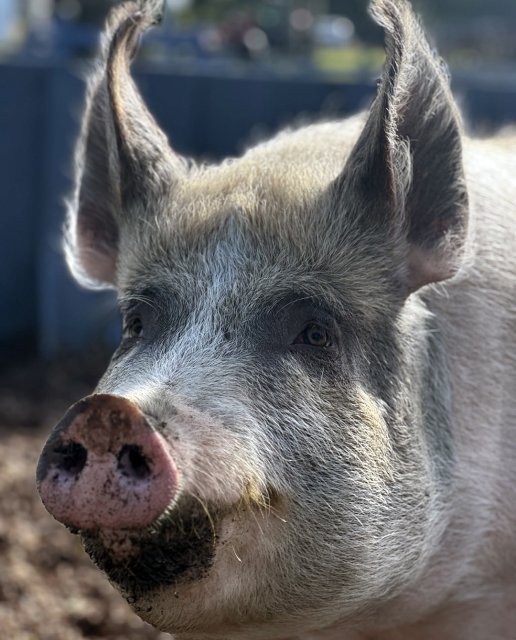
Pig
Pigs raised as livestock are known as domestic pigs and descend from the wild boar. While they have cloven hooves, they are not ruminants like the park's other cloven-hoofed residents. They have stout bodies, short legs, and short, thick necks. Their foreheads are flat, their snouts fairly long, and their eyes relatively small. They have small, curled tails and sparse coats. Their coarse hairs are called bristles and were once used in toothbrushes; today, they are primarily used in various cleaning brushes and paintbrushes.
Most pigs are white, though some have dark or spotted coats. Sows give birth to an average of 10 to 12 piglets per litter and have 14 teats, so the entire litter can usually nurse at the same time. Within the first 24 hours, each piglet claims a specific teat and continues nursing exclusively from it.
Family structure
Boar, sow, and piglet
Breeding season
Year-round
Number of offspring
10 to 12 piglets on average
Arrival in Iceland
During the settlement era
Weight
200 to 250 kg
Gestation period
Three months, three weeks, and three days (114 to 116 days)
Uses
Meat, skin, and hair
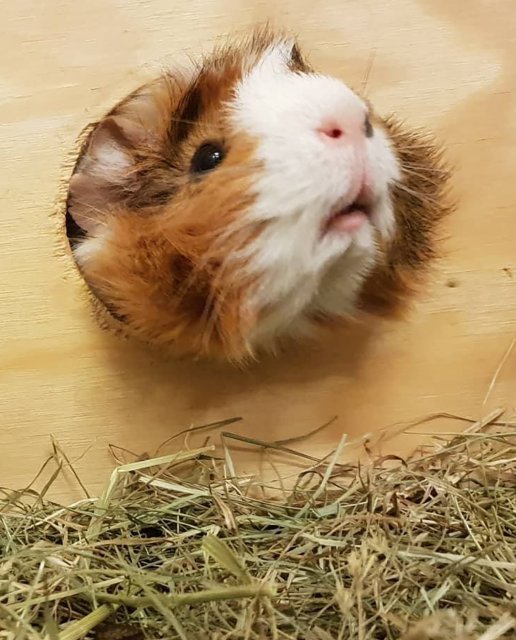
Guinea pig
Guinea pigs originally come from South America (Ecuador, Bolivia, and Peru). They lived on the grassy slopes of the Andes. People in South America began keeping guinea pigs as domestic animals about 3,000 years ago. The Inca, an Indigenous people of South America, and others living in the Andes were among those who bred guinea pigs. Guinea pigs are therefore considered among the first animals domesticated by humans.
Guinea pigs were originally raised for food and later also used in animal sacrifices (500–0 B.C.). To this day, communities in the Andes keep guinea pigs as pets and for food. In Iceland, guinea pigs are kept as pets and live for three to five years.
Family structure
Male, female, and pup
Breeding season
Year-round
Number of offspring
1–5 pups
Arrival in Iceland
Unknown, but they arrived in Europe in the 17th century
Weight
800 to 1,200 grams
Gestation period
50 to 60 days
Uses
Pet
