Improvements to preschool learning and work environments

Reykjavík City is working on improvements to the learning and work environment in preschools. The proposals address the structure of the preschool day, children's hours of stay, and a new fee schedule. The goal is to safeguard the quality of early childhood education, reduce unpredictable understaffing, and ensure stability for children, parents, and staff.
Proposals for changes to the fee schedule
The changes include an updated fee schedule. You can see how the changes might affect your preschool fees using the proposal calculator. It's based on total household income per year. Discounts for staff and siblings will still apply.
About the proposals
Changes to the learning and work environment of preschools have been approved following extensive consultation. The approved proposals can be found in the City Executive Council's meeting documents.
Impact of the changes - examples
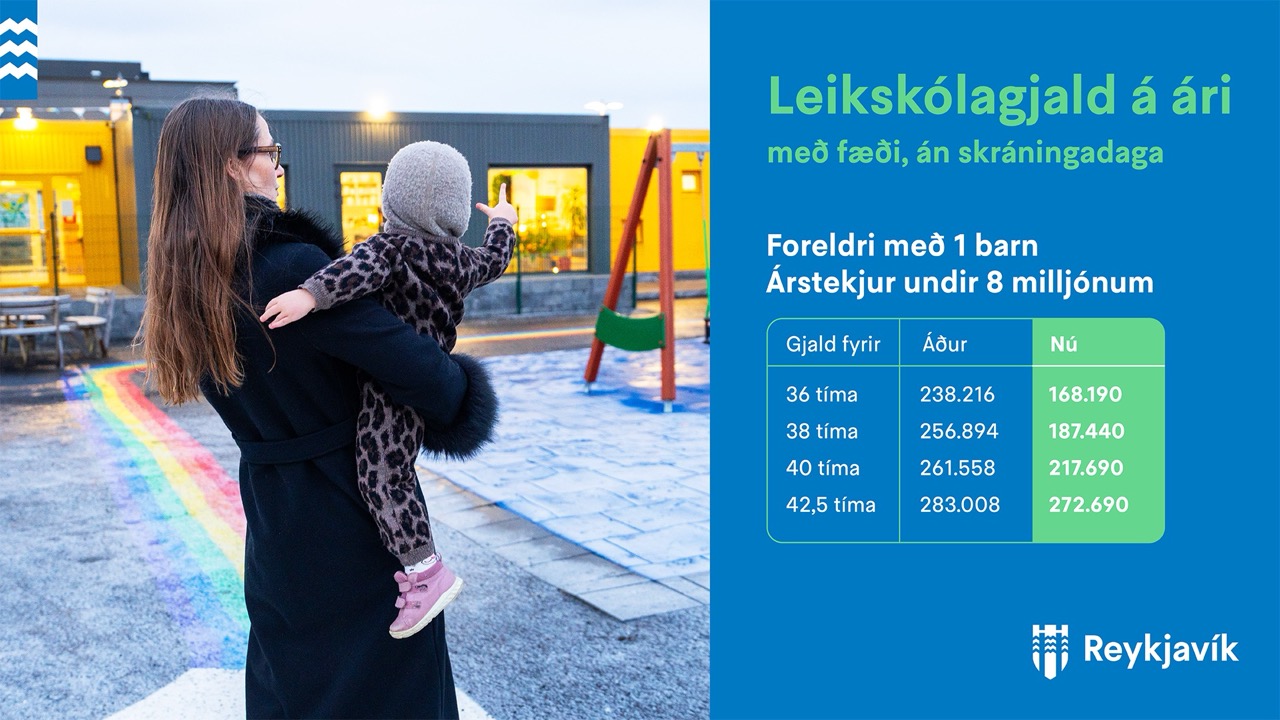
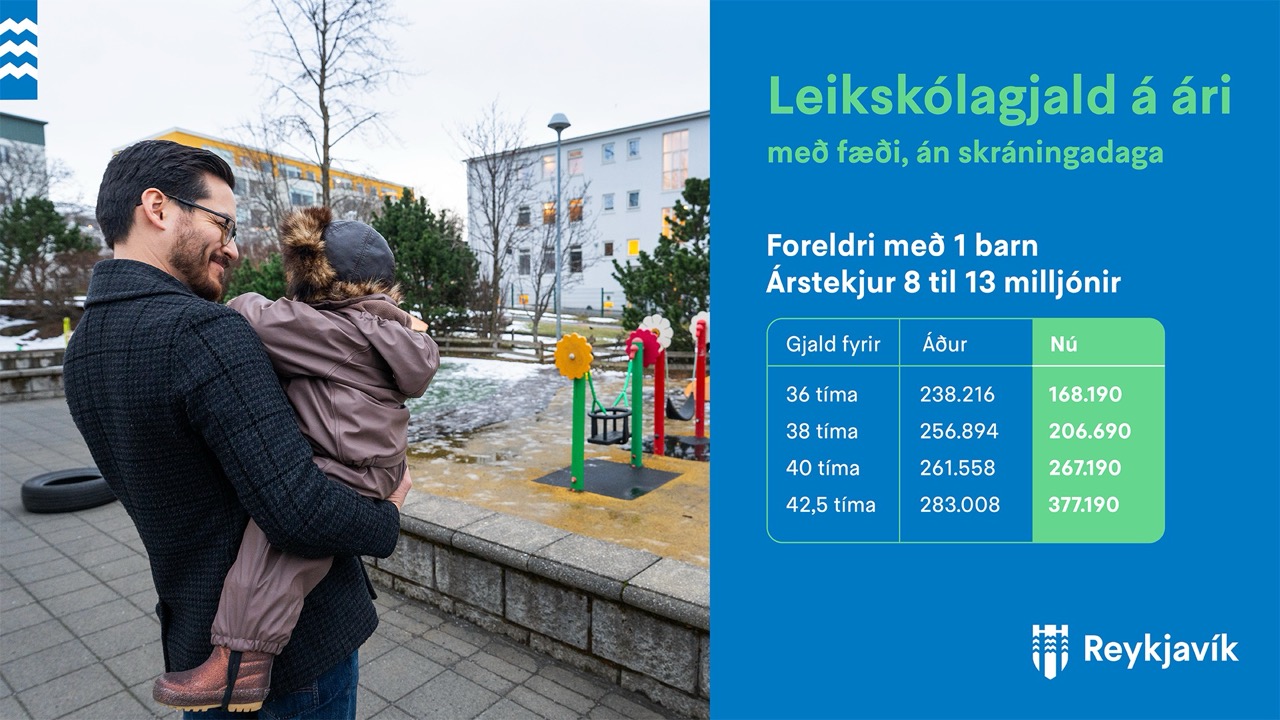
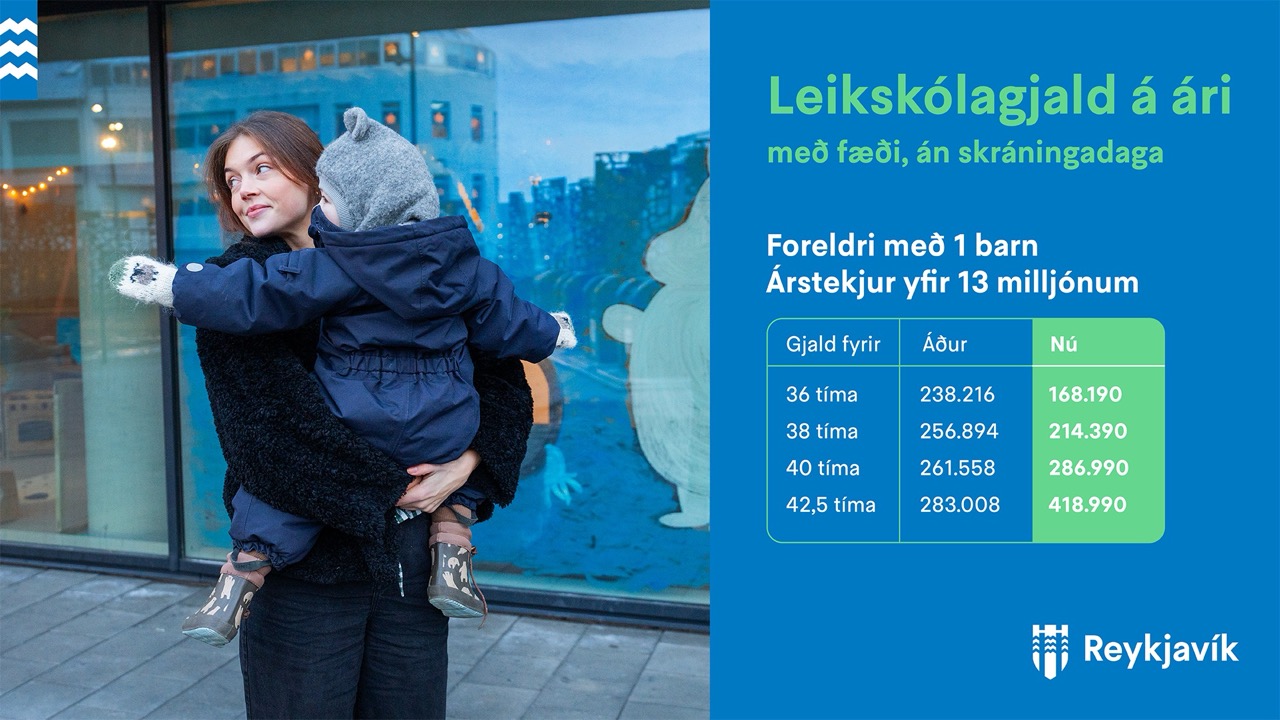
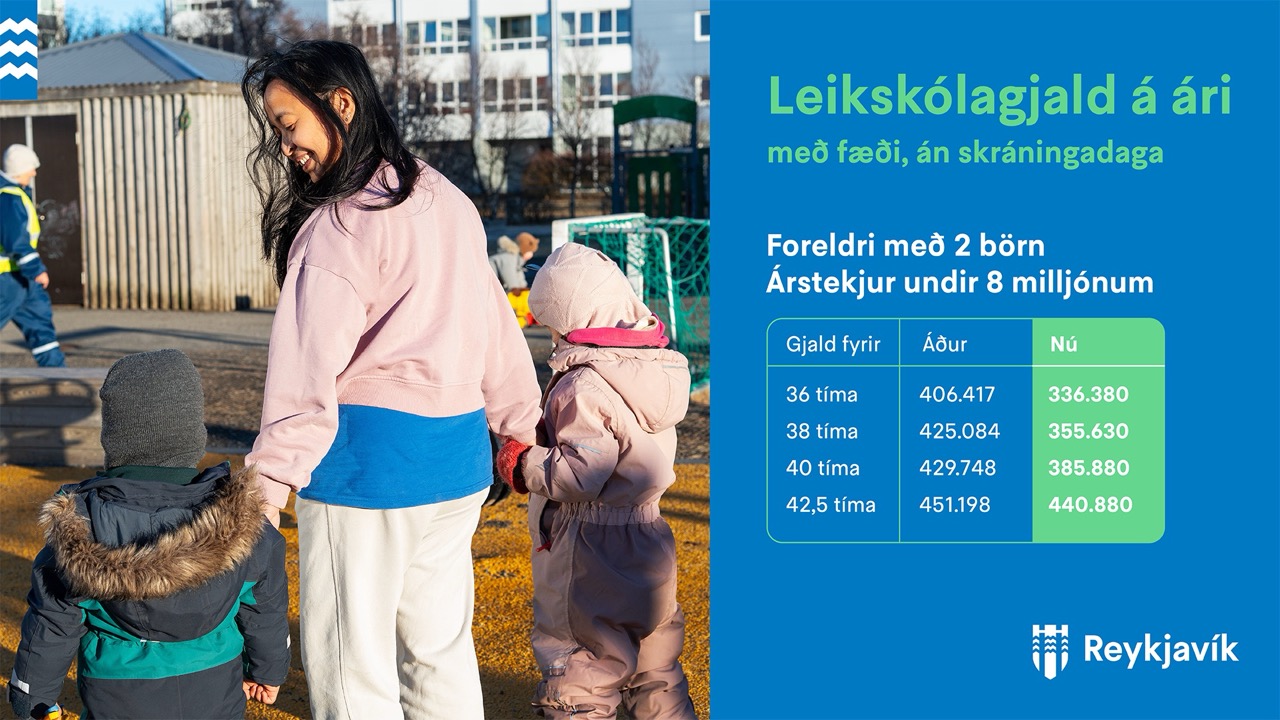
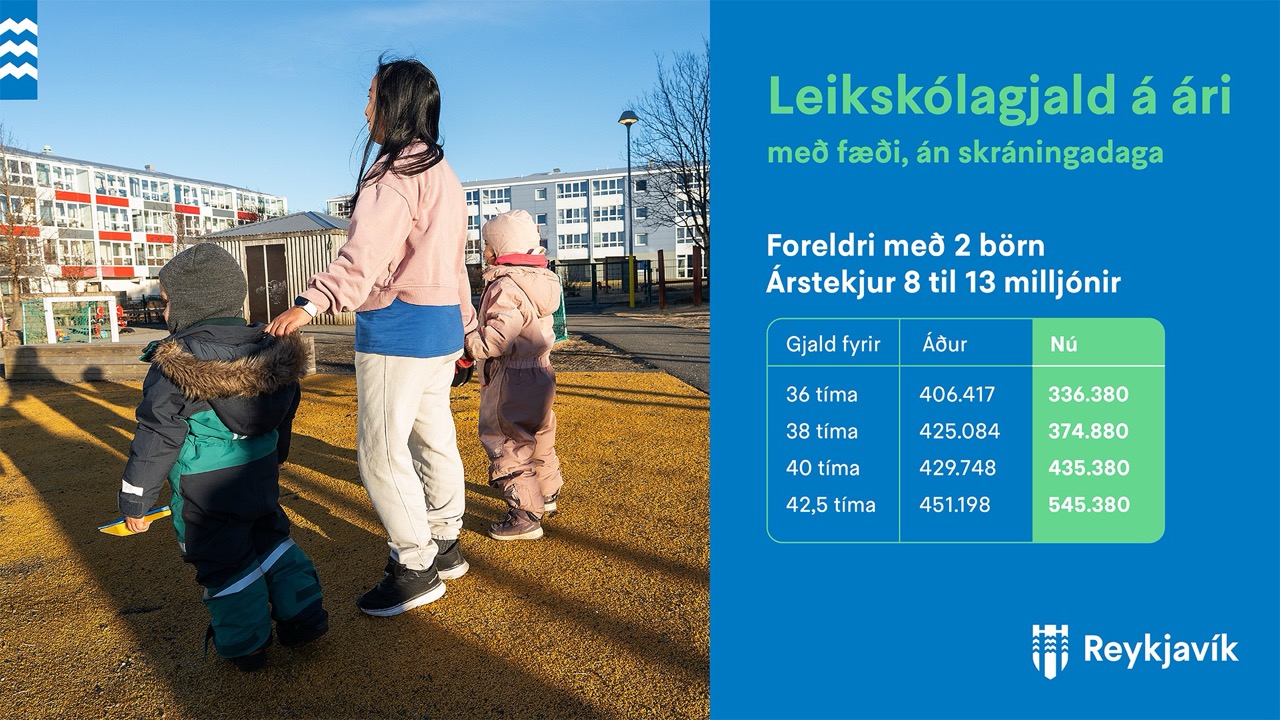
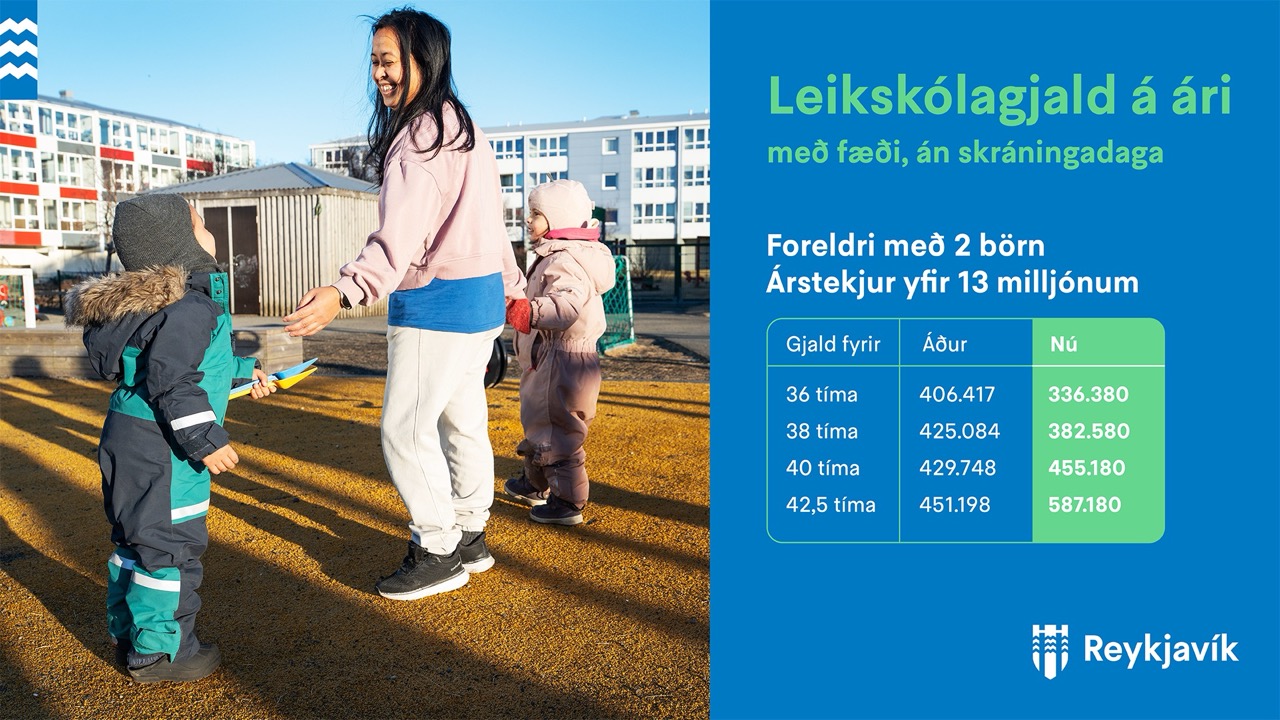
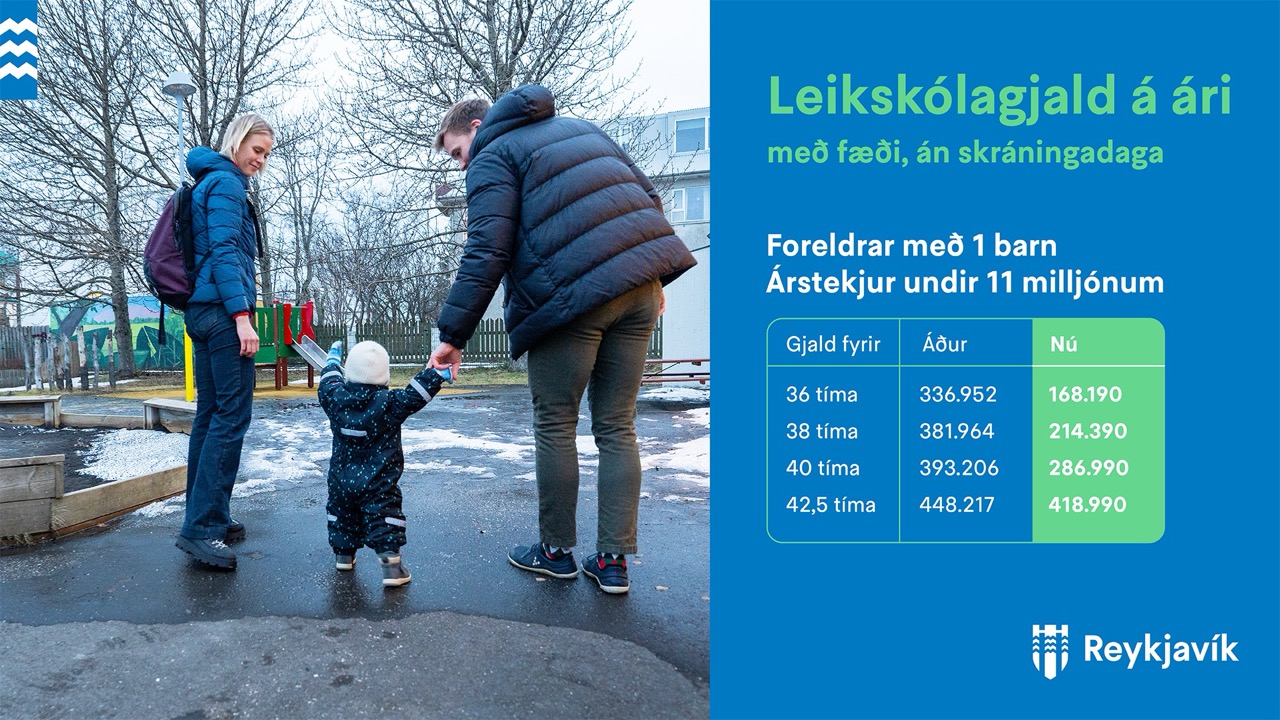
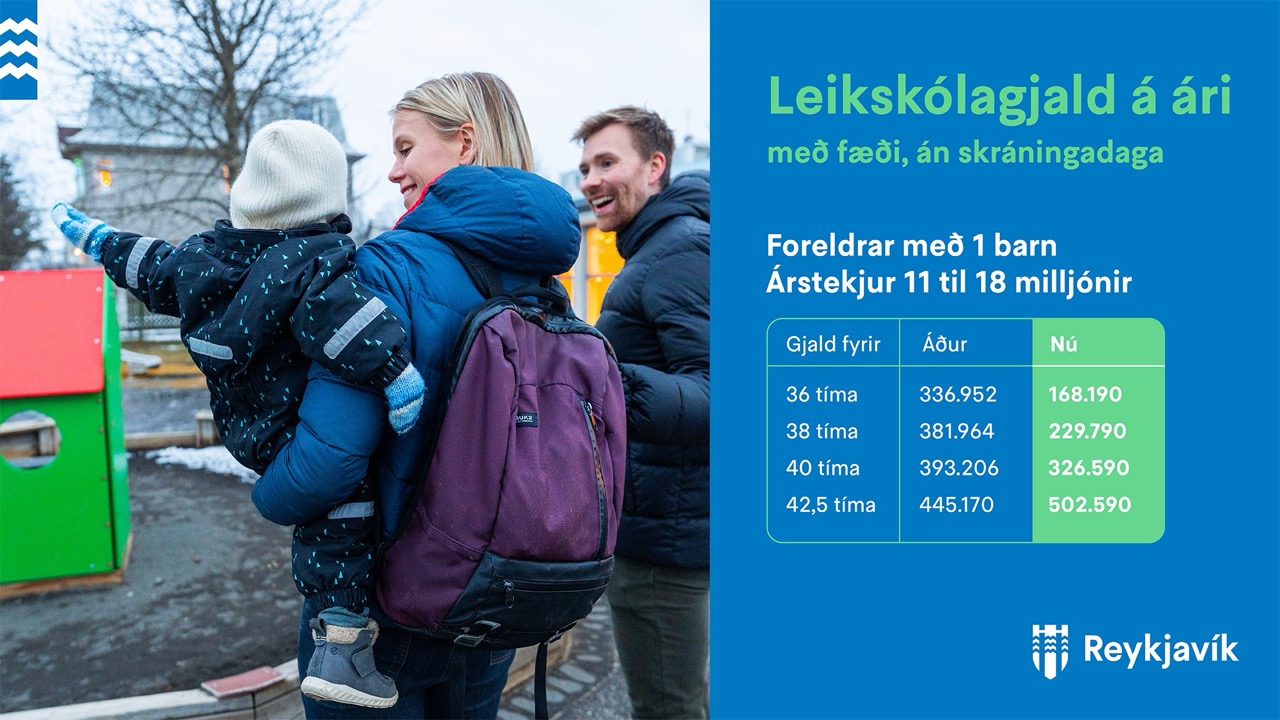
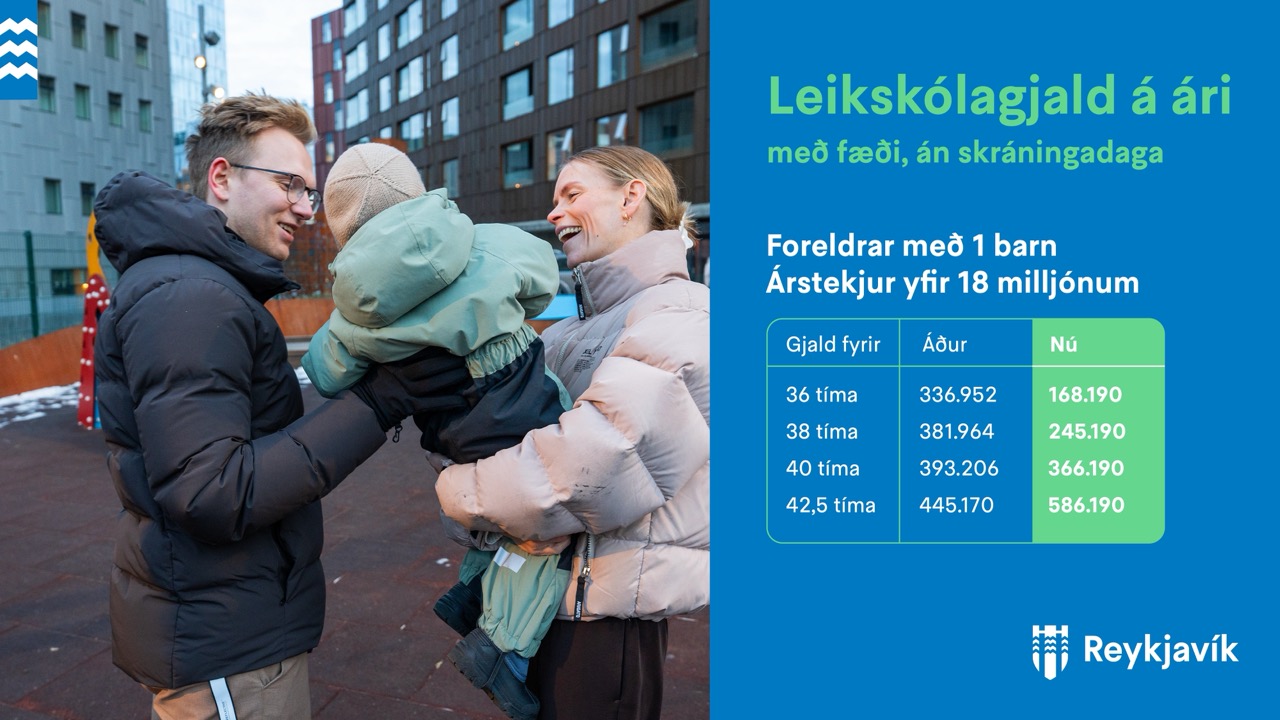
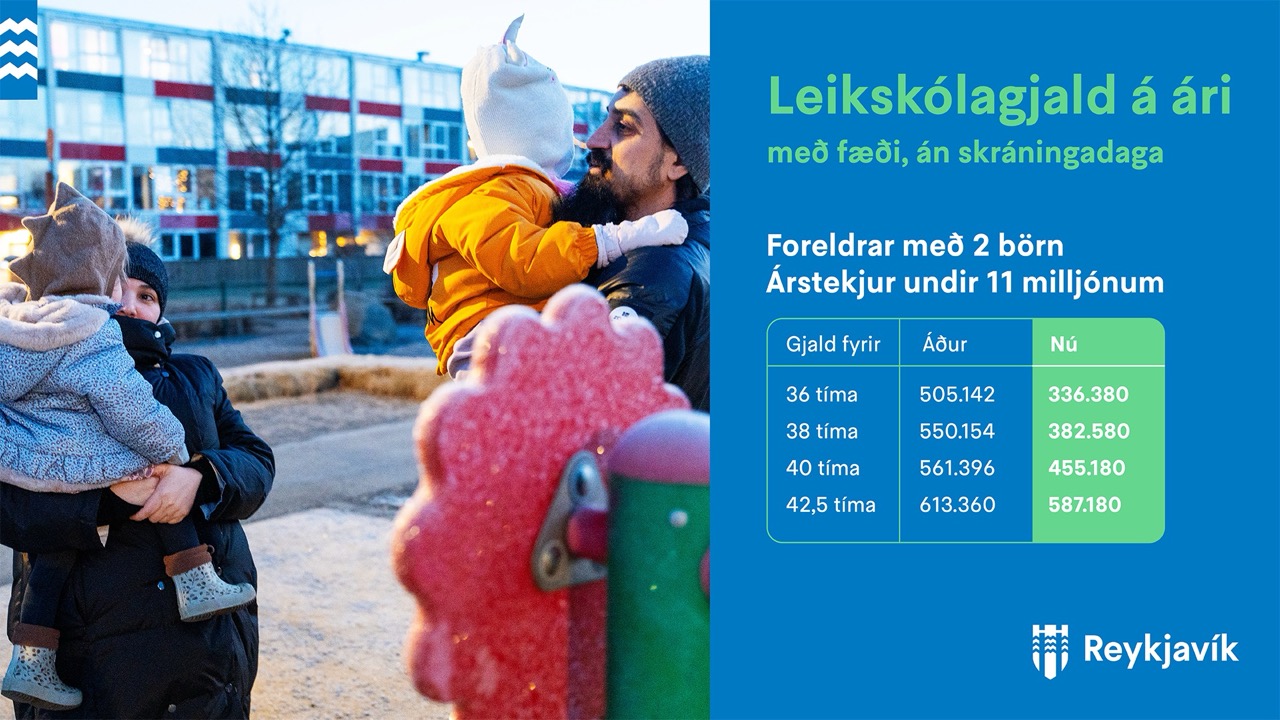
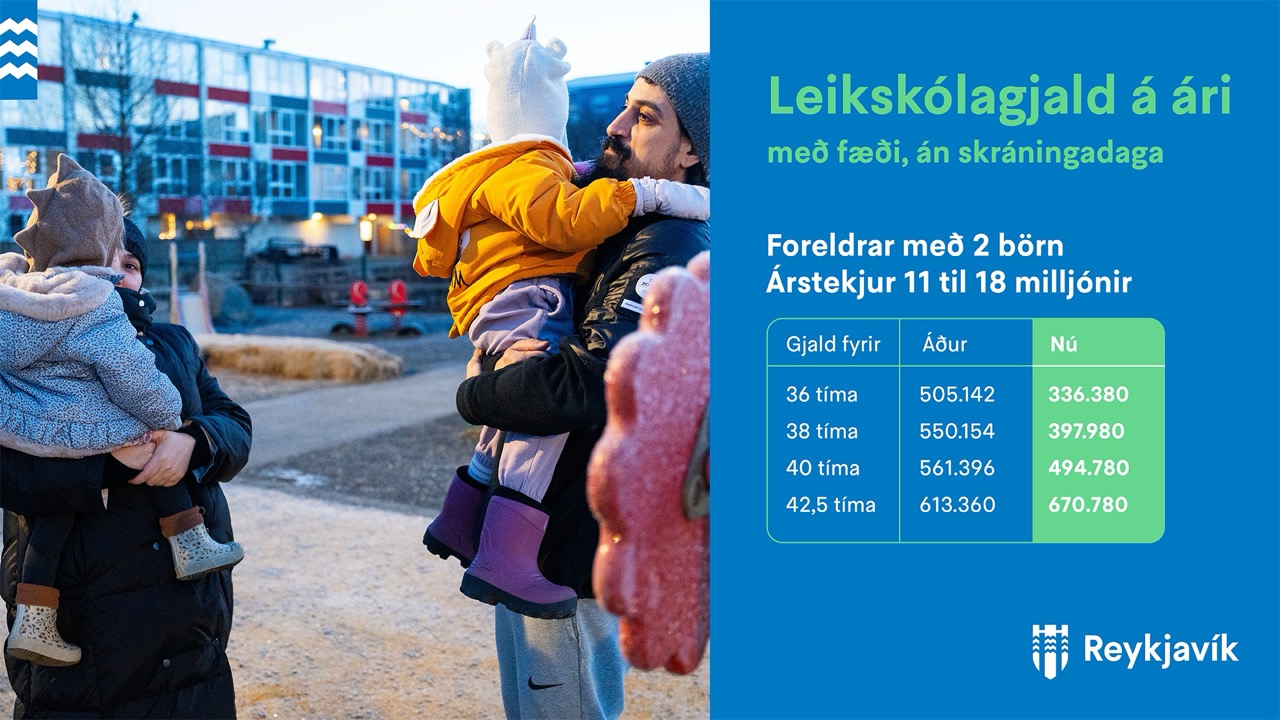
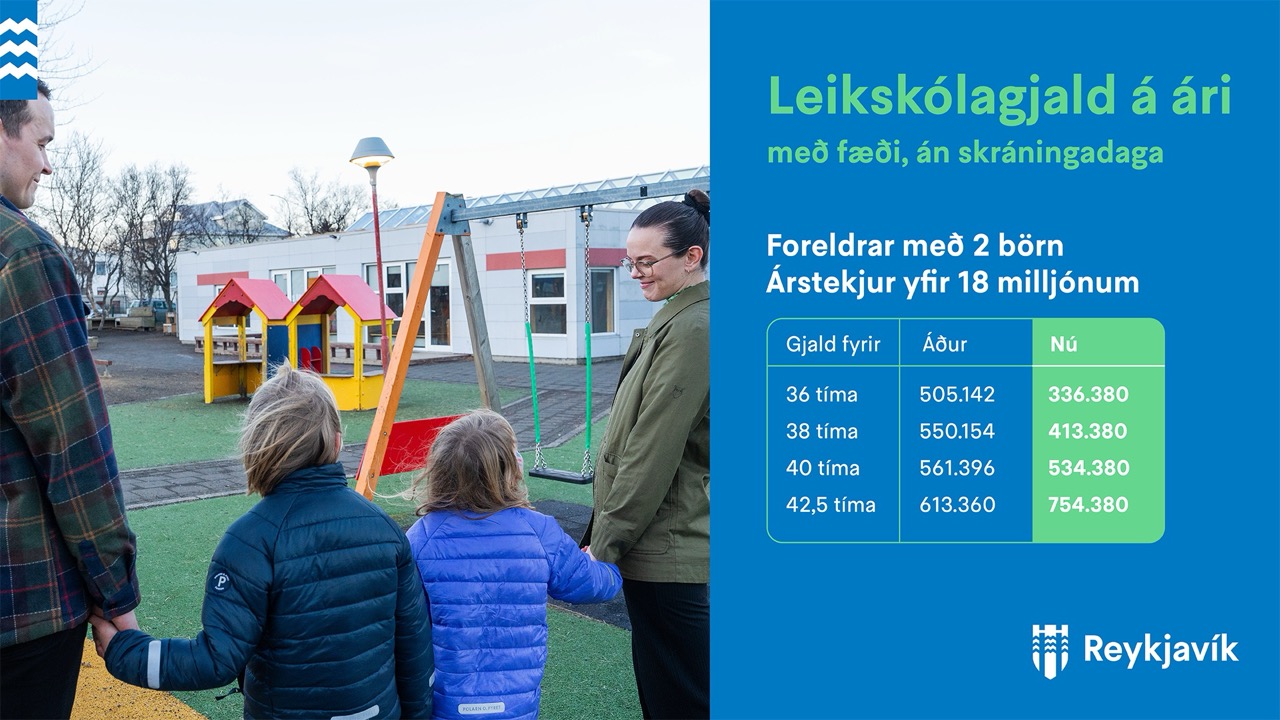
Examples of changes to preschool fees
Parent with one child
Annual preschool fees include meals but exclude optional care days.
| Annual income under 8 million kr. | Annual income 8–13 million kr. | Annual income over 13 million kr. | ||||
|---|---|---|---|---|---|---|
| No. of hours | Before (kr.) | Now (kr.) | Before (kr.) | Now (kr.) | Before (kr.) | Now (kr.) |
| 36 | 238,216 | 168,190 | 238,216 | 168,190 | 238,216 | 168,190 |
| 38 | 256,894 | 187,440 | 256,894 | 206,690 | 256,894 | 214,390 |
| 40 | 261,558 | 217,690 | 261,558 | 267,190 | 261,558 | 286,990 |
| 42.5 | 283,008 | 272,690 | 283,008 | 377,190 | 283,008 | 418,990 |
Parent with two children
Annual preschool fees include meals but exclude optional care days.
| Annual income under 8 million kr. | Annual income 8–13 million kr. | Annual income over 13 million kr. | ||||
|---|---|---|---|---|---|---|
| No. of hours | Before (kr.) | Now (kr.) | Before (kr.) | Now (kr.) | Before (kr.) | Now (kr.) |
| 36 | 406,617 | 336,380 | 406,617 | 336,380 | 406,617 | 336,380 |
| 38 | 425,084 | 355,630 | 425,084 | 374,880 | 425,084 | 382,580 |
| 40 | 429,748 | 385,880 | 429,748 | 435,380 | 429,748 | 455,180 |
| 42.5 | 451,198 | 440,880 | 451,198 | 545,380 | 451,198 | 587,180 |
Parents with one child
Annual preschool fees include meals but exclude optional care days.
| Annual income under 11 million kr. | Annual income 11–18 million kr. | Annual income over 18 million kr. | ||||
|---|---|---|---|---|---|---|
| No. of hours | Before (kr.) | Now (kr.) | Before (kr.) | Now (kr.) | Before (kr.) | Now (kr.) |
| 36 | 336,952 | 168,190 | 336,952 | 168,190 | 336,952 | 168,190 |
| 38 | 381,964 | 214,390 | 381,964 | 228,790 | 381,964 | 245,190 |
| 40 | 393,206 | 286,990 | 393,206 | 326,590 | 393,206 | 366,190 |
| 42.5 | 448,217 | 418,990 | 445,170 | 502,590 | 445,170 | 586,190 |
Parents with two children
Annual preschool fees include meals but exclude optional care days.
| Annual income under 11 million kr. | Annual income 11–18 million kr. | Annual income over 18 million kr. | ||||
|---|---|---|---|---|---|---|
| No. of hours | Before (kr.) | Now (kr.) | Before (kr.) | Now (kr.) | Before (kr.) | Now (kr.) |
| 36 | 505,142 | 336,380 | 505,142 | 336,380 | 505,142 | 336,380 |
| 38 | 550,154 | 382,580 | 550,154 | 397,980 | 550,154 | 413,380 |
| 40 | 561,396 | 455,180 | 561,396 | 494,780 | 561,396 | 534,380 |
| 42.5 | 613,360 | 587,180 | 613,360 | 670,780 | 613,360 | 754,380 |
Fee schedule and discounts
Who is eligible for discounts under the new fee schedule?
The proposals are based on guardians' income, calculated from the total annual income reported on their tax returns. Staff and sibling discounts will still apply.
Tuition discounts are available for single parents at varying levels based on income, and for married or cohabiting couples with a combined income of up to 18 million ISK.
How does tuition change if hours of stay exceed 36 hours?
- For each additional half-hour between 36 and 38 hours, tuition increases by 1,750 kr.
- For each additional half-hour between 38 and 40 hours, tuition increases by 2,750 kr.
- For each half-hour added after 40 hours, tuition increases by 4,000 kr.
Tuition discounts are based on the guardian's income and calculated using total annual income according to their tax return. Employee and sibling discounts remain in effect.
What is the food fee in the new fee schedule?
Under the proposals, meal fees remain unchanged. It is 15,290 kr. for breakfast, lunch, and afternoon snack. If hours of stay are under 35 hours, the afternoon snack is not included, and the fee becomes 12,233 kr. Food fees change regularly.
How do income-based discounts work?
For single parents
- Annual income under 8 million kr. → 75% discount on tuition
- Annual income between 8-13 million kr. → 50% discount on tuition
- Annual income over 13 million → 40%
For married couples or cohabitants
- Annual income under 11 million kr. → 40% discount on tuition
- Annual income between 11-18 million kr. → 20% discount on tuition
What about discounts for disabled persons, single parents, and students?
Special discounts for these groups will be discontinued. Instead, new income criteria will ensure that those with the lowest incomes receive discounts.
Who receives staff discounts?
Reykjavík preschool staff receive a 50% discount on tuition.
Are discounts combined?
No, the highest discount applies, and discounts are not combined.
How does the sibling discount work?
The sibling discount is 100% of the tuition for the older child, plus 100% off the food fee for the third child and any subsequent children.
How do I apply for a preschool fee discount?
Applications for income-based discounts or employee discounts can be submitted through umsokn.vala.is
">Here is an instructional video
- On the front page, click the "Afslættir" tab.
- Click the blue "Sækja um afslátt" button in the upper right corner.
- From the dropdown menu, choose the income bracket that best fits your family or select the employee discount.
- Check both boxes to provide your consent.
- Finally, click "Sækja um."
Your tuition discount application is now complete, and you will receive an email confirmation.
Hours of stay
Why does attendance have to be within a specific time period?
Attendance starts between 7:30 a.m. and 9 a.m. Maximum hours of stay are 42.5 hours per week, which equals about 8.5 hours per day. You can choose different hours of stay for different days of the week.
All hours at the preschool are quality hours designed for children's age, development, and individual circumstances. However, the preschool should organize the key elements of its curriculum within a 5- to 6-hour period each day in a predictable and purposeful way.
This includes group activities, field trips, teacher-guided play, and educational documentation. Outside this time, the structure is more flexible and emphasizes free, spontaneous play, safety, well-being, and individualized care.
How does tuition change if hours of stay exceed 36 hours?
- For each additional half-hour between 36 and 38 hours, tuition increases by 1,750 kr.
- For each additional half-hour between 38 and 40 hours, tuition increases by 2,750 kr.
- For each half-hour added after 40 hours, tuition increases by 4,000 kr.
Tuition discounts are based on the guardian's income and calculated using total annual income according to their tax return. Employee and sibling discounts remain in effect.
What impact do shorter hours of stay have on early childhood education?
Shorter hours of stay enable preschools to plan their educational programs more effectively and ensure more stable operations. It also makes it easier to meet new staff work-hour agreements and reduces the likelihood of service disruptions due to understaffing.
How do you apply for a change in hours of stay?
Requests to change hours of stay are submitted through Vala.
The preschool director must approve the change.
Due to ongoing fee schedule changes, the following deadlines apply for processing applications:
- Applications received March 1-15, 2026, take effect April 1, 2026.
- Applications received March 16-31, 2026, take effect April 15, 2026.
- Applications received April 1-15, 2026, take effect May 1, 2026.
Starting May 1, 2026, regular rules for changing hours of stay under the Rules on Preschool Services will resume, requiring one month advance notice.
Can hours of stay vary by day?
Yes. You can choose different hours of stay for different days of the week, depending on your family's wishes and needs. You can test different schedules in the calculator to see the impact on fees.
Optional care days
What are optional care days?
On optional care registration days, care is optional and preschool fees are waived for days the child is on holiday. If you need care for a child on these days you need to register and pay fees for those days. The fee for optional care days is 5,000 ISK per day. The sibling discount is 50% for the younger child and 100% for the third child.
The general rule is that optional care days follow the City's primary school holidays around Easter, winter break and Christmas.
Optional care registration periods:
In October – coinciding with primary school winter break
In December – between Christmas and New Year's
In February – coinciding with primary school winter break
In March/April – during Holy Week / the week before Easter
When are optional care days?
Optional care days are:
- 3 days in October (primary school winter break)
- 2-4 days in December (days between Christmas and New Year)
- 1 day in February (primary school winter break)
- the three days before Easter (the week leading up to Easter)
Each preschool's annual calendar lists the optional care days.
How much does each optional care day cost?
Each optional care day costs 5,000 kr., which is added to the monthly fee.
Discounts on optional care days for siblings are 50% for a younger sibling and 100% for a third child. No other discounts are available for optional care days.
Where and when do I register my child for optional care days?
Registration for optional care days opens twice a year: Sept. 10–20 for the fall semester and Jan. 10–20 for the spring semester. Registration is on Vala.
What does it mean to register a child for optional care days?
When a child is registered for optional care days, they can attend preschool on those days. The monthly fee does not cover optional care days. Each day costs 5,000 kr., added to that month's bill.
Why do you need to register a child for optional care days?
Registration helps the preschool plan its operations. It helps estimate how many staff members need to be on duty and how many children will be eating meals.
What if the child isn't registered for optional care days?
If the child isn't registered for optional care days, they cannot attend preschool on those days.
What happens if a child is registered for optional care days but doesn't attend?
Registration is binding for optional care days. If a child doesn't attend due to illness or other reasons, parents still must pay for each day the child is registered.
Sibling consideration and sibling grouping
How does sibling consideration work?
Opportunities for siblings to get openings at the same preschool have been expanded under the new rules. Sibling consideration applies generally, but sibling grouping will now apply during main enrollment.
Sibling consideration means that when one opening is available, we check if we can offer the next child an opening at another preschool that parents have chosen so siblings can be placed together, provided certain conditions are met.
How does sibling placement work?
Opportunities for siblings to get openings at the same preschool have been expanded under the new rules. Sibling consideration applies generally, but sibling grouping will now apply during main enrollment.
The new rules go further to unite siblings during main enrollment through what's called sibling grouping. When one opening is available, we check if we can offer openings to up to three children at another preschool that parents have chosen so siblings can be placed together, provided certain conditions are met.
What are the requirements for sibling consideration and sibling placement?
Specific requirements apply to both sibling consideration and sibling placement:
a) Sibling consideration and sibling placement are possible when one opening remains at the older sibling's preschool.
b) The older child/sibling has at least six months remaining in preschool or is not transferring to another preschool when the younger
child starts at the preschool.
c) Parents have chosen the older sibling's preschool as their first choice for the younger child.
d) The older sibling already has active enrollment at the preschool in question.
e) The younger child is at enrollment age at the time.
f) The older child on the waitlist has been offered an opening at one of the
preschools that parents have chosen.
Staffing and understaffing
How is staffing planned for different times of the day?
The focus is on ensuring maximum staffing based on the number of children for 36 hours per week. On optional care days, fewer staff are needed.
What have been the challenges regarding staff work obligations and children's hours of stay?
Staff work 36 hours per week, but many children stay 40 hours or more per week. This creates imbalances and puts stress on staff, children, and parents. These proposals are intended to address this issue more effectively.
How many preschools had to resort to staffing-related service reductions in 2024?
49 of 67 city-run preschools had to resort to such measures at some point during the year. In most cases, this was a safety precaution due to insufficient staffing.
Early childhood education, leave, and opening hours
When will the preschools be open?
Preschools will remain open from 7:30 a.m. to 4:30 p.m. all weekdays.
Preschools are closed six days a year for planning days. Of these, three coincide with professional development days for primary school staff. Planning days are published in the school calendar and announced well in advance.
Preschools are closed on Christmas Eve, New Year's Eve, and for an average of 20 weekdays for summer vacation. Preschools will be closed on the second day of primary school winter break in February.
There are 9-11 optional care days per year. The preschool remains open, but attendance must be registered.
How will early childhood education be scheduled around Christmas, New Year's, the week leading up to Easter, and winter breaks?
The preschool will be open to children who are registered for care on optional care days. Staffing will match the number of children who need care on these days. The fee is 5,000 kr. for each optional care day.
Preschools will be closed on the second day of primary school winter break in February.
When is summer vacation in preschool?
Children in Reykjavík preschools take at least 20 weekdays of summer vacation. The preschool director decides whether the preschool will stay open all summer or close for 10-20 consecutive weekdays. If your child's preschool stays open all summer, you can request to split the summer vacation into two parts. Please send requests to split a child's summer vacation to the relevant preschool director.
What does it mean for the preschool to organize key elements of the school curriculum within 5-6 hours a day?
All hours at the preschool are quality hours designed for children's age, development, and individual circumstances. However, the preschool should organize the key elements of its curriculum within a 5- to 6-hour period each day in a predictable and purposeful way.
The preschool director determines how this time is specifically used. This is when the preschool's main activities take place: core educational programming based on the national curriculum, the preschool's own policies and philosophy, and the Reykjavík Education Policy.
This includes group activities, field trips, teacher-guided play, and educational documentation. Outside this time, the structure is more flexible and emphasizes free, spontaneous play, safety, well-being, and individualized care.
Consultation Portal - View suggestions
The consultation on improving the learning and working environment in preschools has ended.
Work has now begun to analyze the submitted suggestions.
Submitted suggestions remain available for viewing.
Thank you for participating.