
Resident habits and barriers in waste sorting and transportation

The Pilot Cities project conducted a survey earlier this year among adult residents in the capital area. The survey asked participants about their transportation and waste sorting habits, the barriers they face when adopting more sustainable behaviors, their views on climate change issues, life satisfaction, social and demographic background, and places they regularly visit in the capital area.
The University of Iceland's engineering department led the research.
Pilot Cities is a research and innovation project that examines the habits and barriers of capital area residents regarding transportation and waste sorting. The aim is to reduce greenhouse gas emissions faster in line with Reykjavík City's goal of carbon neutrality by 2030.
Transportation
Results show that most respondents use cars to get around. The farther a household is from the city center, the more likely residents are to use a car regularly. Even those who live close to their workplace use a car for more than 50% of their trips. However, many of those who drive to work seem interested in switching to other transportation options, as only 36% say they would prefer a car as their primary mode of transport.
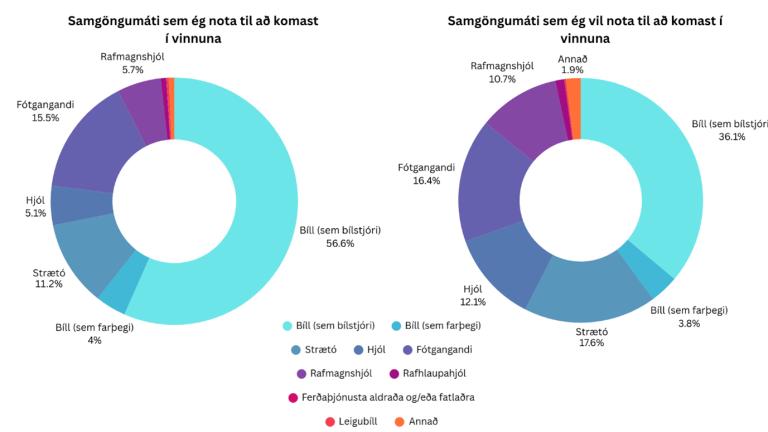
Statistical analysis of respondents' main transportation methods found that public transportation users are more likely than those who use active transportation (such as walking or cycling) to own a car, mainly because of its reliability. While some mainly use public transportation or active transportation for their daily commute, they still own a car to run daily errands.
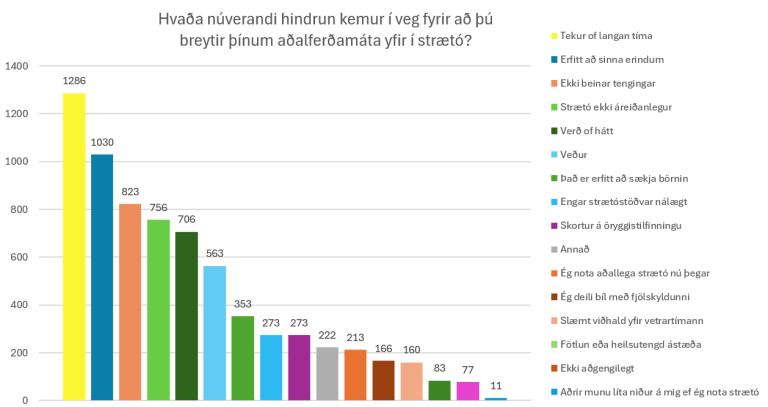
The main barriers to switching to public transportation as a primary mode of travel include long travel times, high costs, a lack of direct connections, and unreliable service.
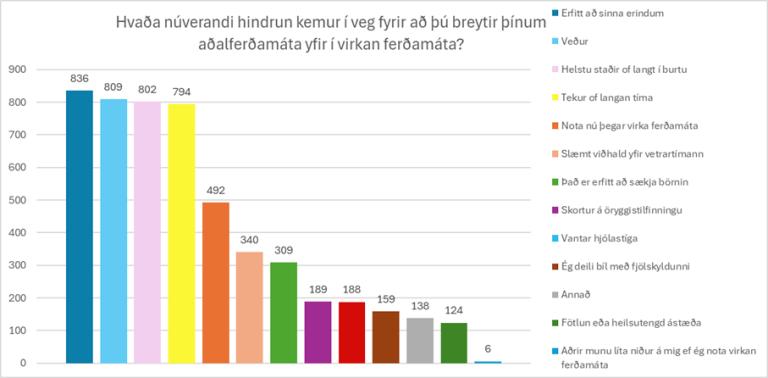
Barriers to switching to active transportation were similar: difficulty running errands, key locations too far from each other, and traveling by active transportation taking too long. As with public transportation, women were more likely to cite errands and time as barriers. Those who live farther from downtown are also more likely to view all of the above as barriers to switching to active transportation.
Recycling and sorting
Similar to transportation, the survey asked about residents' current sorting habits and the main barriers to sorting more or sorting differently. Most respondents sort the main waste categories collected from their homes: paper, plastic, organic, and mixed waste. Less glass and metal is sorted, likely because this requires special trips to public recycling bins or to Sorpa's recycling centers.
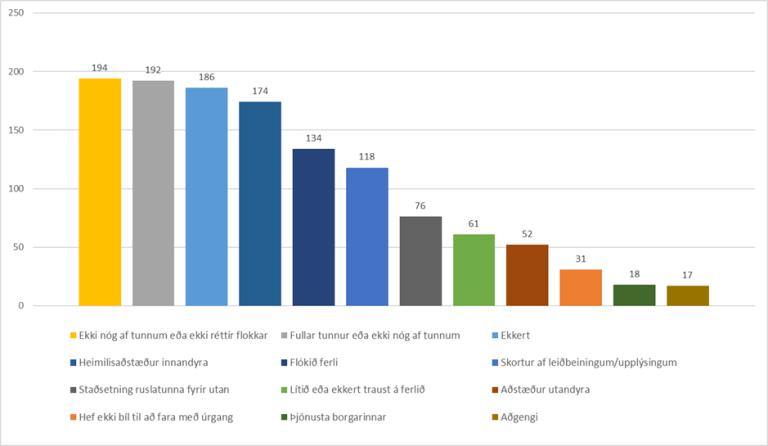
The main barriers mentioned include the lack of the right types or a sufficient number of recycling bins at home, bins that are often full, infrequent collections, and not enough space inside the home to sort different waste categories. Many also felt the process was too complicated and that there was a lack of information about how to sort waste.
Residents in Grafarvogur and Grafarholt were least satisfied with waste collection services, while residents in downtown Reykjavík were among the most satisfied. Those who live in single-family homes were more likely to be satisfied with their indoor space for sorting and with the sorting system as a whole.
Researchers at the University of Iceland will soon conduct focus group interviews with survey respondents from all city neighborhoods to gain a deeper understanding of these barriers.
