Levels of suspended particulates and nitrogen dioxide increase

Suspended particulates (PM10) levels were high at the monitoring station on Grensásvegur in the city following this morning's traffic on Dec. 2.
Wind speed was only about 1 m/s according to the Meteorological Office website at 11 a.m., and the forecast calls for light winds throughout the day. At 10 a.m., the hourly suspended particulates reading at Grensásvegur was 186.3 micrograms per cubic meter and 80.3 micrograms per cubic meter at noon. Suspended particulates levels have also been high at the monitoring station in Dalsmári in Kópavogur, with the highest 10-minute reading reaching 153.9 micrograms per cubic meter at 11: 40 a.m. Nitrogen dioxide levels have also increased at the same monitoring stations.
With light winds, dry streets, and no precipitation in the forecast today, suspended particulates levels will likely spike again during the afternoon commute. Similar weather is forecast for the next few days, so suspended particulates levels will likely remain high. Highways in urban areas and main arterial streets will be treated with a dust suppressant tonight to reduce airborne particles. Dust suppression is a joint effort between Reykjavík City and the Icelandic Road and Coastal Administration.
People with respiratory conditions, older adults, and children should avoid extended outdoor activity and limit physical exertion near major roadways. Today and over the next few days, officials are urging the public to reduce personal vehicle use when possible, postpone non-essential trips, use public transportation, carpool, or choose other environmentally friendly travel options. Officials also urge companies to encourage employees to work remotely if possible and to reduce driving.
Environment Agency Air Quality Website
Reykjavík Public Health closely monitors the city's air quality and issues warnings and guidance when needed. Current levels of suspended particulates and other pollutants can be tracked at loftgæði.is. The site displays a map of monitoring stations in Reykjavík and other locations across the country.
The Environment Agency's air quality website rates air quality using these color codes:

Very good = Little to no air pollution. Likely no health effects.
Good = Minor air pollution. Little to no health effects.
Acceptable = Some air pollution. Very sensitive individuals and people with asthma or other underlying lung and heart conditions may experience symptoms due to higher levels of air pollutants.
Suspended particulates
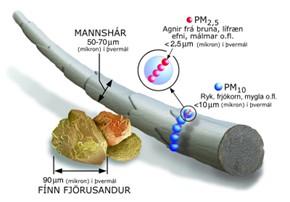
Suspended particulates are the finest type of dust particles that easily enter the respiratory system. Health protection limits are set at 50 micrograms per cubic meter per 24-hour period for PM10 (suspended particles about 10 micrometers in size). The main sources of suspended particulates are road dust from worn asphalt, soot primarily from diesel combustion, soil particles, salt, ash, and other materials.