
Language and literacy
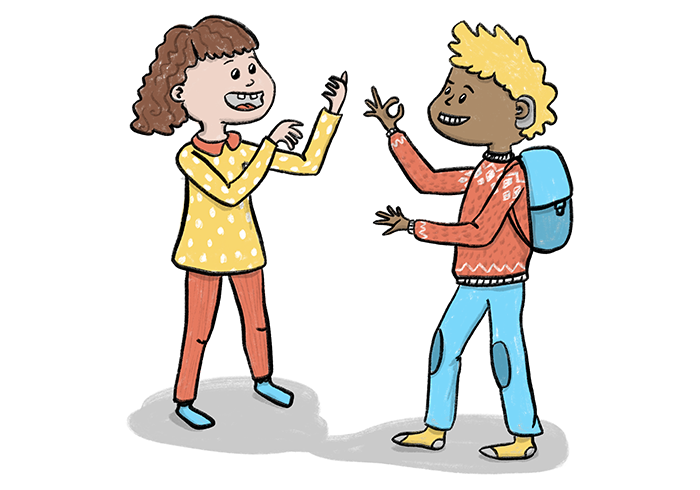
Language involves using words, gestures, and sounds to communicate and acquire knowledge.
Linguistic development describes how children learn this system.
This development continues throughout life and directly impacts literacy. Mastering literacy requires a solid grasp of the language itself.
Talk with children and teenagers
Mastering language and literacy takes a team effort. Parents play the crucial role, but everyone interacting with a child shapes their linguistic development.
Spend time together and talk. Chat and have fun.
- Discuss what the family is doing and recall events from the child's life.
- Make a habit of narrating your daily activities.
- Build home routines that foster communication. Smart devices, computers, screens, loud music, and other noise can hinder communication.
- Discuss the world around you. Talk about your environment, the people in your lives, and current events.
- Explore topics deeply through conversation. Ask open-ended questions that require more than a simple yes or no.
Avoid correcting the child's language. Instead, try repeating what they said correctly.
Adults are role models
Children learn valuable information about desirable behavior by watching their parents.
- Demonstrate an interest in books, reading materials, and reading itself. Share what you read or your thoughts on the material.
- Let the child see you enjoying books and magazines.
- Let the child see how you use cookbooks, nonfiction, joke books, and other texts.
- Write down notes, like grocery lists, and bring the child along.
Reading at home
Reading at home provides essential practice in reading and reading comprehension, while shaping the child's attitude toward learning.
Give undivided attention when listening to the child read.
Focus the child's attention on the text's meaning, asking questions about the material and beyond.
Celebrate every small victory and encourage the child.
Case
Phonological awareness
Phonological awareness is the facet of linguistic development tied to reading. Only when we recognize that language comprises sounds and can discuss these small components are we truly ready to read.
Honing these skills is critical for becoming a strong reader.
Reading comprehension
Reading comprehension means understanding the core meaning of words and sentences. It incorporates broader language comprehension—understanding both spoken and written forms.
Phonemic awareness
Phonemic awareness is the ability to identify letter sounds and map them to their corresponding symbols. Anchored in a language's sound system, it plays an essential role in both speaking and reading.
Vocabulary
Building vocabulary helps children grasp that words stand for specific ideas or concepts. Expanding their word bank and understanding those terms deeply is indispensable.
Reading fluency
Reading fluency draws on automaticity, accuracy, and the rhythmic elements of language. It ensures children read accurately, with a steady pace and appropriate phrasing.
Literacy
Listening comprehension
Listening comprehension, or language comprehension, entails understanding what words and sentences signify. This includes interpreting spoken language, listening actively, and processing sounds.
Phonemic awareness
Phonemic awareness is the ability to identify letter sounds and map them to their corresponding symbols. Anchored in a language's sound system, it plays an essential role in both speaking and reading.
Phonological awareness
Phonological awareness is the facet of linguistic development tied to reading. Only when we recognize that language comprises sounds and can discuss these small components are we truly ready to read.
Honing these skills is critical for becoming a strong reader.
Vocabulary
Building vocabulary helps children grasp that words stand for specific ideas or concepts. Expanding their word bank and understanding those terms deeply is indispensable.
Reading fluency
Reading fluency draws on automaticity, accuracy, and the rhythmic elements of language. It ensures children read accurately, with a steady pace and appropriate phrasing.
Reading comprehension
Reading comprehension means understanding the core meaning of words and sentences. It incorporates broader language comprehension—understanding both spoken and written forms.
