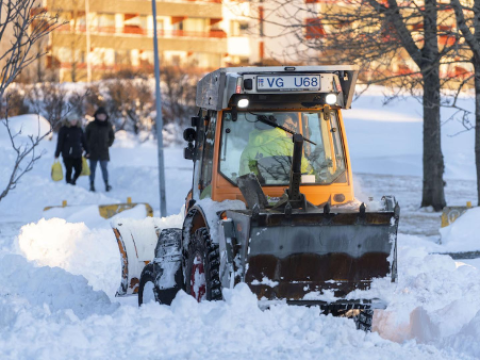
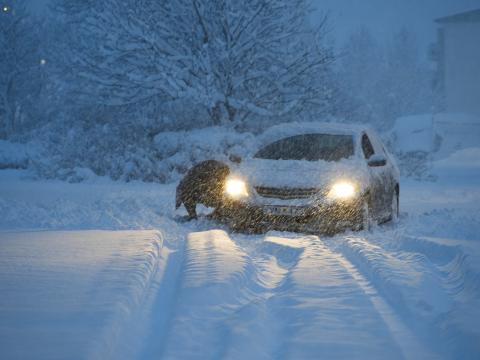
A steering group presented proposals to review winter maintenance services to Reykjavík City's Environment and Planning Council this morning. The steering group aimed to identify necessary changes to improve service efficiency and cost-effectiveness.
The group put forward 16 proposals and an action plan with roughly 40 steps, most of which they expect to implement before next winter. Officials estimate the proposals will increase the annual cost of winter maintenance services by around 190 million króna.
Reykjavík City continuously reviews and develops its winter maintenance services. Recent improvements include extending walking and biking path services to weekends since 2020, and successfully switching from sand to salt for path deicing.
The 16 proposals
- Raise the snow removal service level for residential streets
- Review snow clearing procedures
- Explore the feasibility of proactive steps to prevent snow accumulation
- Improve snow removal on walking paths, bus stops, and pick-up and drop-off points in the city center
- Define procedures for managing ice formation on heated streets
- Find a solution for winter maintenance of walking paths in Vesturbær and Þingholt
- Calibrate service levels to snow depth
- Introduce a targeted severe weather response plan for winter maintenance services
- Help set public expectations that align with the service level being delivered
- Leverage technology to improve public information and measure performance
- Improve the handling of and response to suggestions
- Improve snow removal procedures in collaboration with the contractors performing the work
- Strengthen collaboration with neighboring municipalities and the Icelandic Road and Coastal Administration
- Strengthen oversight of winter maintenance services
- Review procurement contracts
- Review winter maintenance considerations in new planning projects and street redesigns
More equipment assigned to residential streets and benchmarks revised
Proposed steps include raising the service level for residential streets so that snow removal begins at a snow depth of 10 cm rather than 15 cm. The plan also proposes increasing the number of vehicles serving residential streets so that clearing can typically finish within 48 hours of snowfall ending.
Special focus on pedestrians and cyclists
The group paid particular attention to pedestrians and cyclists, dedicating three of the proposals to pathways and bus stops. The proposals recommend clearing snowbanks from pedestrian crossings on priority 1 and 2 paths within 48 hours of the last snowfall. Crews would also clear snow from bus stops and pick-up and drop-off points within 48 hours of the last snowfall. Both standards apply when snow depth is up to 15 cm.
The overall effort will improve snow removal procedures. Under the guiding principle that crews should not place snowbanks on sidewalks, the city will explore how to prevent snowbank buildup along walking paths. Crews are still mapping the areas and paths where they should not leave snowbanks.
Clearing calibrated to five snow event categories
The group proposes revising the service manual to calibrate snow removal to snow depth. Clearing times would then vary based on the measured depth of accumulated snowfall. The group proposes defining five snow event categories based on snow depth. This classification would enable a better response during heavy snowfall.
- Snow event 1: Up to 5 cm of accumulated snow
- Snow event 2: 5-15 cm of accumulated snow
- Snow event 3: 15-25 cm of accumulated snow
- Snow event 4: 25-50 cm of accumulated snow
- Snow event 5: over 50 cm of accumulated snow
The group proposes updating procurement contracts to reflect the revised service levels where applicable. Clearing times will generally be shortest for snow event 1 and longest for snow event 5.
The City will also introduce a targeted severe weather response plan for winter maintenance services, linking responses to the Meteorological Office's warning system and coordinating with civil protection alert levels in the capital area to improve public communication.
Oversight to be strengthened
Monitoring covers two areas: road conditions and the implementation of winter maintenance services. Crews will monitor winter maintenance operations and progress around the clock, conducting regular on-site inspections of snow removal work.
Robust road condition monitoring enables a more reliable response to ice and snow at any hour. Stronger operational oversight serves two purposes: verifying that snow removal is carried out in accordance with contract specifications and ensuring consistent work practices across all contractors. All snow removal vehicles feature GPS tracking.
Additional actions
Additional proposed actions include exploring the feasibility of installing snow-melting systems in dense areas with little room for snowbanks, and designating snow storage and disposal sites during the planning of new neighborhoods and developments.
The city is working to improve how it receives and handles suggestions. One proposal explores letting residents check the Suggestion Portal to see if someone has already reported their issue, which would reduce duplicate reports.
The group also proposed a pilot project to explore proactive steps on streets prone to heavy snow accumulation, such as installing barriers or other snow protection structures to reduce buildup. Streets such as Víkurvegur, Lambhagavegur, and Korpúlfsstaðavegur are examples where crews could apply these steps.