
Háteigsvegur 59 wins European design award
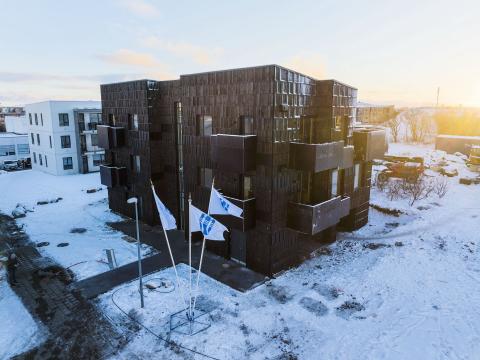
Háteigsvegur 59, a new supported housing cluster developed by Reykjavík City, recently won a New European Bauhaus design award and has garnered considerable attention along the way. Architect Arnhildur Pálmadóttir designed the building, and the intentional effort to reduce its carbon footprint throughout the design process makes this supported housing cluster especially noteworthy. Háteigsvegur 59 took home the prize in the circular society category. Arnhildur believes the honor proves developers can prioritize social connection and well-being while simultaneously cutting emissions, pollution, and material use.
This specific accolade highlights northern regions, specifically Greenland, the Faroe Islands, northern Finland, Norway, Sweden, western Ireland, and Iceland. The program recognized seven projects from Iceland, Sweden, Norway, and Ireland, with three ultimately winning across three categories.
A dignified setting that enriches life
In its official statement, the selection committee noted the project successfully merges "environmental responsibility, social inclusion, and high-quality architecture." Committee members also praised the development's effective carbon reduction and material repurposing, noting it could point the way forward in Iceland by demonstrating the true power of sustainable design. "By balancing clear functionality in spacious rooms with bright and texturally rich surfaces, the project offers residents a dignified setting that enriches their lives," the statement continued.
Seven people live in the supported housing cluster, receiving the support necessary for independent living. The residential units at Háteigsvegur are bright and beautiful, with many offering unmatched views across the city. Its prime location between the Vatnshóll area and Sjómannaskólinn (Merchant Marine Academy) is equally impressive.
Sparking a vital conversation about architecture and material use
"They mean a great deal to me, because the project proves we can build with a focus on social connection and well-being while curbing emissions, pollution, and material use. And we delivered it within a standard budget and timeline, in full compliance with existing systems and regulations," Arnhildur says, reflecting on the honor's broader significance for similar developments. "The initiative has also fostered innovation and crafts, sparking a vital conversation about architecture and material use. Reusing materials creates opportunities to tell stories through the building itself, deepening the experience and adding value," she adds.
The construction sector accounts for roughly 40% of carbon emissions and produces massive amounts of waste, underscoring the need to rethink our methods and discover fresh ways to build better, healthier environments — spaces people genuinely want to be in — while reducing consumption, pollution, and waste.
When asked, she confirmed that she wants to see more circular thinking in future projects. "Absolutely — and this project demonstrates that we can achieve a great deal without major changes. The conversation around environmental issues in construction has sometimes been negative and confusing, even though the challenges that arise are identical to those in conventional builds and have nothing to do with the environmental focus itself. The construction sector generates roughly 40% of carbon emissions and creates enormous amounts of waste, making it critical to revisit our processes and explore new ways to construct better, healthier buildings — spaces people actually want to inhabit — while cutting consumption, pollution, and waste," Arnhildur says.
A focus on reuse and reduced carbon emissions
Arnhildur also won the Nordic Council's environmental award in 2024 for her interdisciplinary approach and commitment to curbing carbon emissions and repurposing building materials. → /node/37465The supported housing cluster opened in late 2024, and during her remarks at the ribbon-cutting, Arnhildur noted the team had slashed the carbon footprint by 53% compared to a standard reference building. Among the salvaged materials, leftover stone tiles from the construction of Smiðjan — the Alþingi office building — found a new purpose in the supported housing cluster, where they now line the entrance hall floor. Grafa og grjót donated the stonework. Other reclaimed materials included surplus lumber from Húsasmiðjan, extra windows from Gluggagerðin, and additional leftover wood from Byko — all donated by those companies to the project.
Numerous other partners contributed in various ways to the development and design of the cluster. More → byggjumgraenniframtid.is/h59/details about the development and its partners are available on a website created by the Housing and Construction Authority.
