
"We advocate for service users and protect their interests"
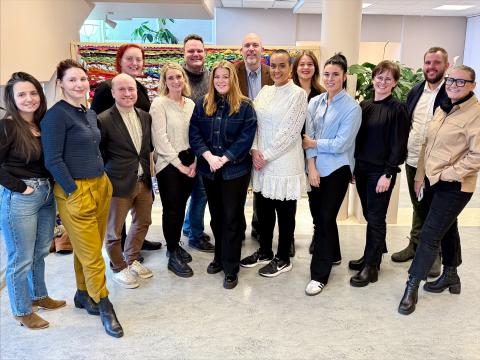
The Vitatorg Community Center was packed this morning for Welfare Coffee, an open meeting of Reykjavík City’s Welfare Council. The discussion focused on services for homeless people with complex needs. The topic clearly resonates with many, as about 130 people followed the meeting, either in person or via livestream.
Reykjavík City operates a variety of housing programs for individuals who have experienced homelessness and have complex service needs. The Department of Welfare provides 24-hour services to 26 individuals. This includes 11 women living in an apartment complex, 15 men in long-term housing, and six in a temporary housing program for individuals taking their first steps into stable housing after prolonged homelessness.
Additionally, the housing division of Reykjavík City's Outreach and Counseling Team (VoR Team) supports about 50 individuals, either in "Housing First" apartments located throughout the city or in tiny homes found in several locations across town. "Housing First" refers to providing individuals with housing without requiring abstinence from alcohol or drugs.
The outreach division of the VoR Team provides support in many locations, including city shelters, as well as in cars, tents, stairwells, parking garages and more.
Consensus on the future direction of the field
Soffía Hjördís Ólafsdóttir, division head for services to homeless people with complex needs, reviewed the development of these services in recent years and presented a new action plan that has broad support and was unanimously approved by City Council earlier this year.
The plan includes twelve actions in total, which can be viewed here.
The actions include better and more systematic assessment of individual needs when people first seek emergency services. Work is underway to create tiered services and reduce the time individuals spend in emergency shelters. "We're trying to prevent people from becoming trapped in long-term homelessness, partly by assessing their needs when they first arrive at emergency services. This allows us to direct people to less intensive services when appropriate." She added that individuals must have an active housing application to stay in emergency shelters, ensuring progress in their housing situation. "Emergency shelters are for those awaiting housing allocation or who, for various reasons, are unable to secure housing on their own and need temporary emergency accommodation."
The service user as the expert in their own case
Soffía emphasized that as housing options increase, the VoR Team must be strengthened, as support for formerly homeless people to maintain housing is essential. Next on the agenda were representatives from the VoR Team: Þorbjörg Valgeirsdóttir, director of the team; Kolfinna Arndísardóttir, team leader of the housing division; and Simon Agust Steinsson, team leader of the outreach division. The team's services, whether in outreach or housing support, are based on harm reduction and user-centered approaches. "We advocate for service users and protect their interests. Our service is built on the principle that users are the experts in their own situations. "It's our role to understand their desires and aspirations, where they want to live, and how we can best meet their needs," said Kolfinna.
She said the VoR Team staff witnesses various challenges that service users face every day. The digitalization of services and the introduction of electronic ID can be barriers for people who don't always have access to a phone. Communication between systems can be complicated, and various resources available to community residents are often inaccessible to them.
Building a bridge between users and the system
The field staff spends a significant portion of their time traveling between locations to meet people wherever they are. "If people are staying somewhere, it's important that we go there. We strive to be a stable anchor in the turmoil of life for our clients. We try to build a bridge between our clients and the system," said Simon.
"We want to be a steady point in the turbulence of life for our clients."
They all agreed on the importance of building trust between the team staff and service users. This ultimately results in better service for them throughout the entire system. "It's not until we know people and they know us that we can begin to work with them. We do this by considering the wishes, hopes, and dreams of each individual."
Home nursing services for people experiencing homelessness
Arndís Vilhjálmsdóttir is one of two nurses from Reykjavík City home nursing who work with the homeless population in Reykjavík. The team provides nursing care in shelters, in apartment complexes for people with addiction issues, in "housing first" homes, and elsewhere as needed. Arndís explained that the team's role is primarily to ensure continuity in services for this population and to guide matters through appropriate channels. "It's also important to empower clients to navigate the public system. We all have the right to available healthcare services, and it's crucial to guide people toward appropriate resources, such as healthcare centers or specialized programs."
The team's daily tasks vary widely, including assessing infections, monitoring vital signs, changing wound dressings, or accompanying individuals during hospital admissions.
In her work, Arndís notes she has observed how rapidly this population is aging, an issue that requires immediate attention. "It’s deeply concerning that people who have received health and ability assessments remain in emergency shelters. These are individuals who qualify for 24-hour healthcare services but aren't receiving them. Traditional nursing homes lack this specialized approach, but services for this population must be based on harm reduction principles and require staff with specific expertise."
At the meeting's conclusion, the floor was opened for questions, leading to vibrant discussions moderated by Sanna Magdalena Mörtudóttir, chair of the Welfare Council.
