
Þórdís Dröfn Andrésdóttir wins 2025 Tómas Guðmundsson Literary Awards
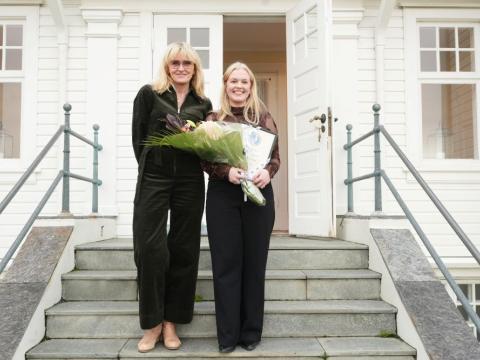
Þórdís Dröfn Andrésdóttir has won the 2025 Tómas Guðmundsson Literary Awards. She received the award for her poetry manuscript "Síðasta sumar lífsins" (The Last Summer of Life). Benedikt Publishers will publish the book. Mayor Heiða Björg Hilmisdóttir presented the award to Þórdís Dröfn today, Monday, Oct. 27, 2025, during a ceremony at Höfði House.
103 unpublished poetry manuscripts submitted
A total of 103 unpublished poetry manuscripts were submitted for this year's competition. This is the highest number of manuscripts ever submitted. This year also marked the first time manuscripts were submitted electronically through Reykjavík City's website, where authors' names were kept anonymous. Reykjavík UNESCO City of Literature manages the awards, which have been awarded since 1994. In 2004, the program was changed to recognize only poetry manuscripts. The award includes a cash prize of 1 million króna. The collection will be released by Benedikt Publishers.

Þórdís Dröfn Andrésdóttir was born in 1997. She earned a bachelor's degree in Icelandic from the University of Iceland and a master's degree in linguistics from Aarhus University. Þórdís Dröfn currently works as an adjunct lecturer in the Department of Icelandic and Cultural Studies at the University of Iceland. She previously served as president of the Association of Icelandic Students Abroad. "Síðasta sumar lífsins" is her first poetry collection.
The selection committee consisted of chair Þorvaldur Sigurbjörn Helgason, Soffía Bjarnadóttir and Brynhildur Björnsdóttir.
Selection committee's official statement:
The winning manuscript for the 2025 Tómas Guðmundsson Literary Awards, "Síðasta sumar lífsins," is a poetic narrative about two lovers on an unnamed sunny island. The manuscript is a bittersweet and melancholy description of endings in the broadest sense — the end of time, love, life and summer as it fades from light into the uncertainty of darkness. Neither the two lovers nor the island they inhabit are ever named, making the experience the poems describe universal, while the poetic images are both specific and unusual — ranging from a familiar memory where fish becomes a symbol of God to cherry pits in an ashtray.
The subjects of the poems in "Síðasta sumar lífsins" are the same themes poets have wrestled with for centuries — love, death, nature, to name a few — but the author approaches these themes with emotional depth, sensitivity and originality. Melancholy winds blow through the poems, evoking nostalgia, the end of love and the sorrow that comes with growing up and leaving the world of childhood behind. The reader also senses tenderness and beauty in small things that raise larger questions about time, which both heals and infects wounds, as the work puts it. Although the work's narrative world is contained, the poems point beyond themselves toward larger realities through references to natural disasters, conflicts and climate change. Despite the work's relatively quiet narrative, an undercurrent of sorrow runs through the poems, and an unexplained danger hovers on the horizon, threatening the island's eternal summer. The work thus becomes a metaphor for modern Western life — a life that, despite being more comfortable and peaceful than ever, is at the same time marked by deep anxiety and storm clouds gathering in the sky. "Home is wherever," the poem reads, reflecting a longing for what is passing away — not what was, but what is slipping through our fingers here and now — raising questions about what and where is home. "Síðasta sumar lífsins" is thus like a peaceful and bittersweet landscape painting of the calm before the storm, just before everything changes forever.
